
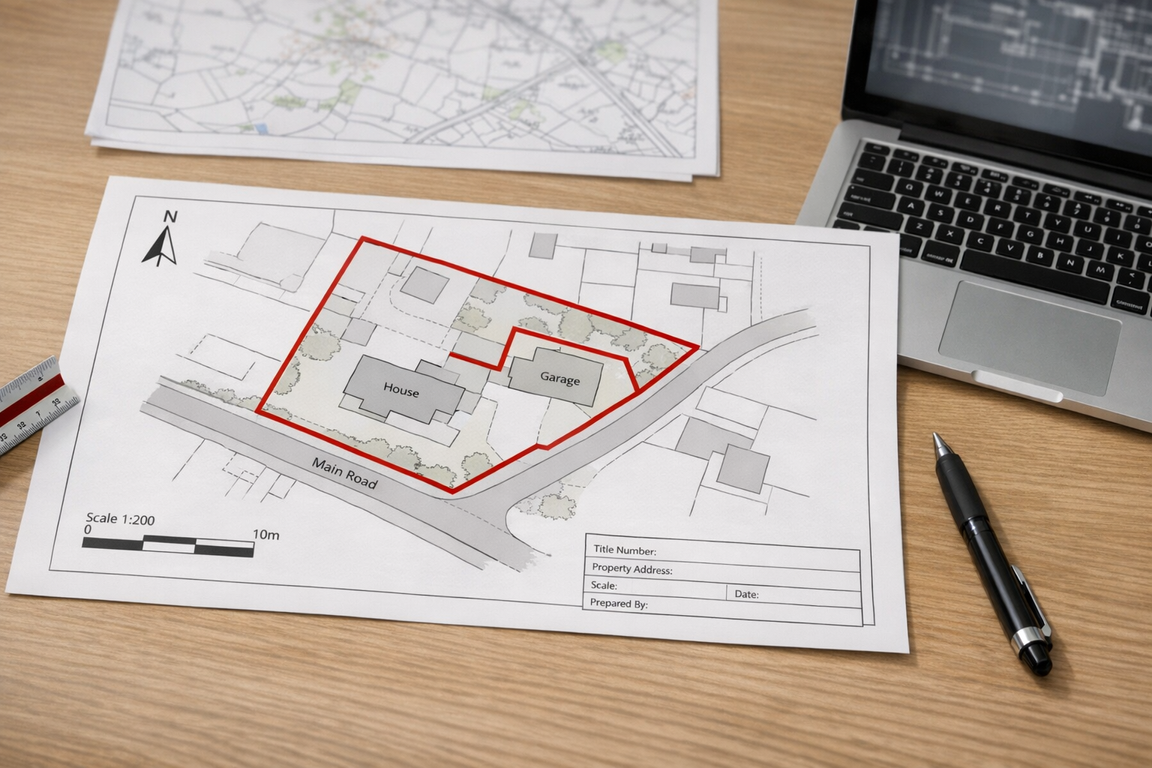
When a property transaction involves more than a straightforward sale of an already-registered title, HM Land Registry needs to be able to answer one key question: what land is being registered, transferred or leased and can it be clearly identified on the Ordnance Survey map?
If the plan supplied with an application is unclear or non-compliant, Land Registry will often raise a requisition (a formal request for clarification or correction). That can mean delays to registration, extra legal costs, and in some cases the need to redraw plans and re-execute documents. For those affected, these delays can affect funding, completions, handovers and onward sales.
For property owners and professionals across the South West, a Land Registry compliant plan prepared correctly is one of the simplest ways to keep the legal process moving and reduce risk.
What Is a Land Registry Compliant Plan?
A Land Registry compliant plan is a plan that meets HM Land Registry’s requirements so the land can be accurately identified and mapped. It must be clear, legible, and drawn so that the extent of the property (or the part being dealt with) is unambiguous.
Land Registry plans are not simply aesthetic, they are legal plans used to define the extent of ownership or leasehold demise. If the plan can be interpreted in multiple ways it may not be accepted, or accepted causing problems later.
Why a Professionally Prepared Compliant Plan Matters
Avoiding Requisitions and Registration Delays
One of the most common reasons for Land Registry requisitions is that the plan does not allow Land Registry to identify the land on the OS map. Issues such as unclear boundary edging, lack of detail around the site, or plans that don’t reproduce well can quickly lead to queries. A professionally prepared plan significantly reduces the risk of any bounce back that would slow registration.
Reducing Future Disputes and Uncertainty
A plan is often relied on years after completion. When a neighbour disputes a fence line, when a freeholder challenges the extent of a garden, or when a buyer asks what is included, if the plan is unclear the scope for disagreement increases. A surveyor prepared plan helps ensure boundaries, extents and key features are represented clearly and consistently.
Ensuring The Plan Matches the Legal Documents
Even a technically sufficient plan can cause problems if it doesn’t align with the wording of the transfer or lease. Our surveyors are used to preparing plans that work with the legal documentation, so what is described in the deed is what appears on the plan, and vice versa.
When Do You Need a Land Registry Compliant Plan?
While many standard sales of whole registered titles can proceed using existing title plans, Land Registry compliant plans are commonly required in three main situations: leases, transfers of part (TP1), and first registration.
1) Lease Plans
Lease plans are a frequent source of delays because the demise can be complex particularly with flats, mixed-use buildings, and modern developments. A Land Registry compliant lease plan is often required where the lease defines areas such as:
· The flat or unit extent
· External areas included within the demise such as gardens, terraces and balconies
· Parking spaces or storage areas
· Bin/cycle stores and communal areas
If the plan does not clearly show what is included and what is excluded, or different areas are not clearly distinguished, Land Registry may raise requisitions. A measured, CAD prepared lease plan helps ensure clarity and compliance from the outset.
2) Transfer of Part (TP1) Plans
A TP1 is used when transferring part of an existing title such as with plot sales, garden land transfers, and splitting larger sites. Land Registry will usually require a plan that clearly identifies the land being transferred. Typical examples include:
· Selling off part of a garden to a neighbour
· Creating a separate building plot
· Transferring part of a farm, estate or larger holding
With transfers of part, small inaccuracies can have major consequences particularly where access, shared driveways, service routes, or retained land are involved. A compliant TP1 plan helps ensure the denoted boundary matches the deal and can be registered without delay.
3) First Registration
Where land is being registered for the first time, or where a new title is being created, Land Registry must be satisfied that the extent is identifiable and can be properly mapped. Older deeds, historic plans, or unclear photocopies can create uncertainty especially where features have changed over time. A current, professional plan can remove ambiguity and support a smoother application process.
Why Use a Building Surveyor for Land Registry Plans?
Land Registry compliance is as much about clarity and accuracy as it is about presentation. Using a building surveyor to produce measured, CAD based plans helps ensure the plan is:
· Based on surveyed information and identifiable site features
· Drawn clearly and consistently for legal use
· Suitable for Land Registry submission and robust enough for future reliance
In short, it reduces the risk that your transaction is delayed by avoidable plan issues and helps protect clients from uncertainty later.
If you’re undertaking a transaction that may require a Land Registry compliant plan, or you’d simply like to check whether one is needed, our building surveyors are happy to talk you through your potential requirements.